Pokémon Pinball Almost Launched as a Metroid Game
The original Pokémon Pinball for the Game Boy Color, a title many of us remember for its surprisingly robust gameplay and integrated rumble feature, almost took a very different thematic direction. Before it became the monster-catching pinball experience we know, the development team at Jupiter considered using the Metroid intellectual property, a choice that would have fundamentally altered one of the Game Boy's most technically interesting spin-offs. The inclusion of a dedicated rumble motor within the cartridge itself was a significant engineering feat for a handheld of its era, pushing the boundaries of what was expected from Game Boy peripherals.
Rumble on the Go: Jupiter's Technical Ambition
The idea for a pinball game with haptic feedback on a portable system originated with Makoto Nakayama, founder of Jupiter. He was inspired by the Nintendo 64's Rumble Pak, a peripheral that plugged into the N64 controller to provide vibration feedback. Nakayama wondered if similar rumble capabilities could be integrated into a Game Boy game, a challenge given the handheld's compact nature and limited power. Jupiter, known for its Picross games and its close relationship with Nintendo, began experimenting.
A successful test cartridge proved the concept was viable. This cartridge contained a small vibration motor, powered by the Game Boy's own battery, allowing for tactile feedback during gameplay. This was a notable technical achievement, as most Game Boy cartridges were passive ROM storage devices. Adding active components like a motor required careful power management and circuit design within the cartridge's physical constraints. The Game Boy Color, released in 1998, offered a slightly more powerful platform than the original Game Boy, but still presented significant limitations for such an ambitious feature.
From Samus to Squirtle: The IP Decision
With the technical hurdle of the rumble feature cleared, Jupiter began to consider which Nintendo property would best suit a pinball game. The team narrowed its choices down to two established franchises: Metroid and Pokémon. Both presented logical fits for the game's central mechanic, where a ball would be the primary interactive element. For Metroid, the ball could be Samus Aran in her Morph Ball form, a familiar and iconic transformation. For Pokémon, a Poké Ball was an obvious choice, aligning perfectly with the core concept of catching creatures.
CBR Games reports that while Metroid had seen success in the US on the NES and Super Nintendo, the decision ultimately favoured Pokémon. This was largely due to the brand's immense popularity in Japan at the time. The original Pokémon Red and Blue games had launched in Japan in 1996, creating a cultural phenomenon. Capitalising on this widespread appeal made strong commercial sense for a new spin-off title. This choice highlights how market trends and regional popularity often influence development decisions, even when a technical concept could work equally well with multiple intellectual properties.
Pinball Mechanics on Game Boy Color
Pokémon Pinball delivered a traditional pinball experience, but with a distinct Pokémon aesthetic. The game featured two main tables, themed after the Red and Blue versions of the original games. Players could switch between these tables, which offered different layouts and Pokémon to catch. The physics engine for the ball was well-regarded, providing a satisfying sense of weight and momentum, crucial for any pinball simulation.
One of the challenges on the Game Boy Color's small, vertically oriented screen was displaying a full pinball table. Jupiter addressed this by implementing screen-switching, where the display would scroll between the upper and lower halves of the table. While this could be jarring in some games, CBR Games notes that Pokémon Pinball executed this transition smoothly, making it as unobtrusive as possible for the hardware. This design choice was a pragmatic solution to the display limitations of the 160x144 pixel screen, ensuring players could still track the ball effectively across the entire playfield.
Beyond standard pinball, the game integrated Pokémon's core "catch 'em all" mechanic. By hitting specific targets on the table, players could enter a "catching mode". This involved collecting items to spawn a Pokémon, then hitting the creature with the pinball multiple times within a time limit to capture it. This added a strategic layer to the gameplay, moving beyond pure score chasing. Captured Pokémon could also be evolved, further encouraging players to engage with the game's unique mechanics and fill their in-game Pokédex.
A Handheld Sales Phenomenon
Upon its release in Japan on 14th April 1999, and shortly after in the US on 28th June, Pokémon Pinball quickly became a commercial success. CBR Games highlights its impressive sales figures, noting it moved 262,000 copies in its first 20 days. This made it the fastest-selling Game Boy game ever at that point, surpassing the record previously held by the original Pokémon Red and Blue. This rapid adoption underscores the immense popularity of the Pokémon brand during its initial boom.
The game ended 1999 as the fifth best-selling game of the year, following Pokémon Red, Blue, Yellow, and Donkey Kong 64. With 5.31 million units sold globally, it was nearly the biggest Pokémon spin-off of all time, only slightly behind Pokémon Stadium on the Nintendo 64, which sold 5.46 million copies. This strong performance for a pinball title, especially one on a handheld, demonstrates the power of a well-executed concept combined with a popular licence. It also shows that players were willing to invest in games that pushed the technical boundaries of their hardware, like the integrated rumble.
The GBA Sequel and DS Spinoff
Nintendo continued the series on the Game Boy Advance with Pokémon Pinball: Ruby & Sapphire, released in 2003. This sequel retained the core mechanics of its predecessor but updated the graphics and sound to take advantage of the GBA's more powerful hardware. It also introduced new Pokémon from the third generation of games, expanding the Pokédex to fill. While a solid entry, it did not replicate the original's meteoric success, selling around 1.3 million copies. This figure is comparable to the Japan-only Pokémon Stadium for the N64, suggesting a more niche appeal for the sequel.
The Metroid franchise, despite being passed over for the original Pokémon Pinball, eventually received its own pinball adaptation. Inspired by Mario Pinball Land for the Game Boy Advance, producer Kensuke Tanabe pushed for a Metroid pinball game. This resulted in Metroid Prime Pinball, released in 2005 for the Nintendo DS. This title drew heavily from the thematic elements of Metroid Prime and notably included vibration support. The DS version achieved this by bundling a Rumble Pak accessory, which plugged into the handheld's Game Boy Advance cartridge slot. This external approach contrasts with the original Pokémon Pinball's integrated rumble, showcasing different hardware solutions for haptic feedback across Nintendo's handheld generations.
Modern Accessibility and Preservation Challenges
As of 2026, the Pokémon Pinball series has not seen a direct continuation in video game form. Neither the original Game Boy Color title nor its Game Boy Advance sequel are available on modern platforms like the Nintendo Switch's online retro libraries. This means that for enthusiasts wanting to experience these games, the options are limited. Players must either acquire original physical cartridges and compatible hardware, such as a Game Boy Color or Game Boy Advance, or turn to emulation.
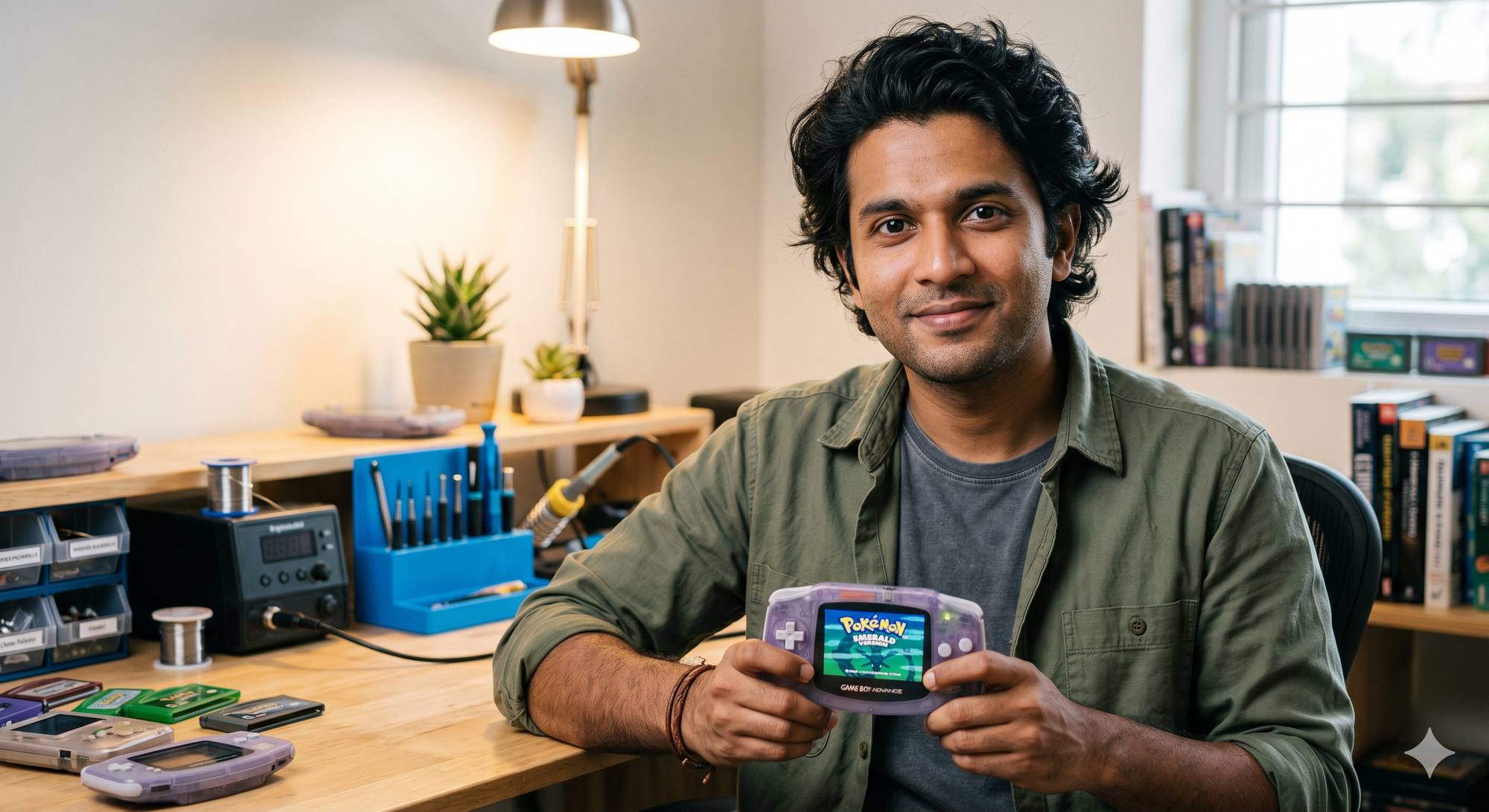
The lack of official re-releases for such a historically significant and commercially successful spin-off is a common challenge in retro gaming preservation. While the original hardware is still functional for many, the screens on these older devices often lack the clarity and backlighting that modern players expect. This is where the modding scene steps in, offering IPS retrofit kits for Game Boy Color and Game Boy Advance, which provide vibrant, backlit displays. However, even with a modded console, the original Pokémon Pinball cartridge with its unique rumble feature is still required for the full experience.
Recently, Stern Pinball, a manufacturer of real-life pinball machines, introduced a new officially licensed Pokémon table. This physical machine, while not a video game, offers a modern interpretation of the Pokémon pinball concept. It features vibrant on-table obstructions, thematic sound design, and even a video screen for catching Pokémon. However, its price point, ranging from $6,999 for the Pro model to $12,999 for the Limited Edition, places it far beyond the reach of the average hobbyist. This makes it more likely to be experienced in public arcades or dedicated gaming spaces rather than in private collections, a stark contrast to the original Game Boy Color game's widespread accessibility.
What This Means for Handheld History
The story of Pokémon Pinball is more than just a tale of a successful spin-off; it is a fascinating look into the technical and commercial considerations that shaped early handheld gaming. The decision to integrate a rumble motor directly into a Game Boy Color cartridge was a bold move, demonstrating a willingness to innovate within the constraints of portable hardware. This kind of hardware-level experimentation is something we see less of today, with most handhelds relying on standardised components.
The real story here is how Jupiter, with Nintendo's support, pushed the envelope for what a Game Boy game could be. The success of Pokémon Pinball proved that players valued novel hardware features, even if they added to the cost or complexity of a cartridge. This willingness to invest in unique experiences, like a rumble-enabled pinball game, speaks volumes about the early Pokémon audience and their enthusiasm for anything related to the franchise. It also highlights the enduring appeal of well-designed pinball mechanics, which translate effectively across different platforms and even into physical machines.
For the handheld modding community, Pokémon Pinball represents a classic example of a game that benefits from original hardware. While emulators can replicate the gameplay, the tactile feedback of the rumble cartridge is a physical sensation that is harder to perfectly reproduce without specific hardware. This makes owning and playing the original cartridge on a well-maintained or modded Game Boy Color a uniquely authentic experience, one that connects players directly to the ingenuity of its original developers.
RetroShell's Player Clothing drops are short-run and numbered — each shirt is a one-off piece. If the run closes, it's not coming back.
Follow RetroShell on X for daily retro gaming news. Join the community on r/RetroShell.
Originally published by CBR Games. Read original article.