
Moonwalker's Darker Legacy for Sega Genesis

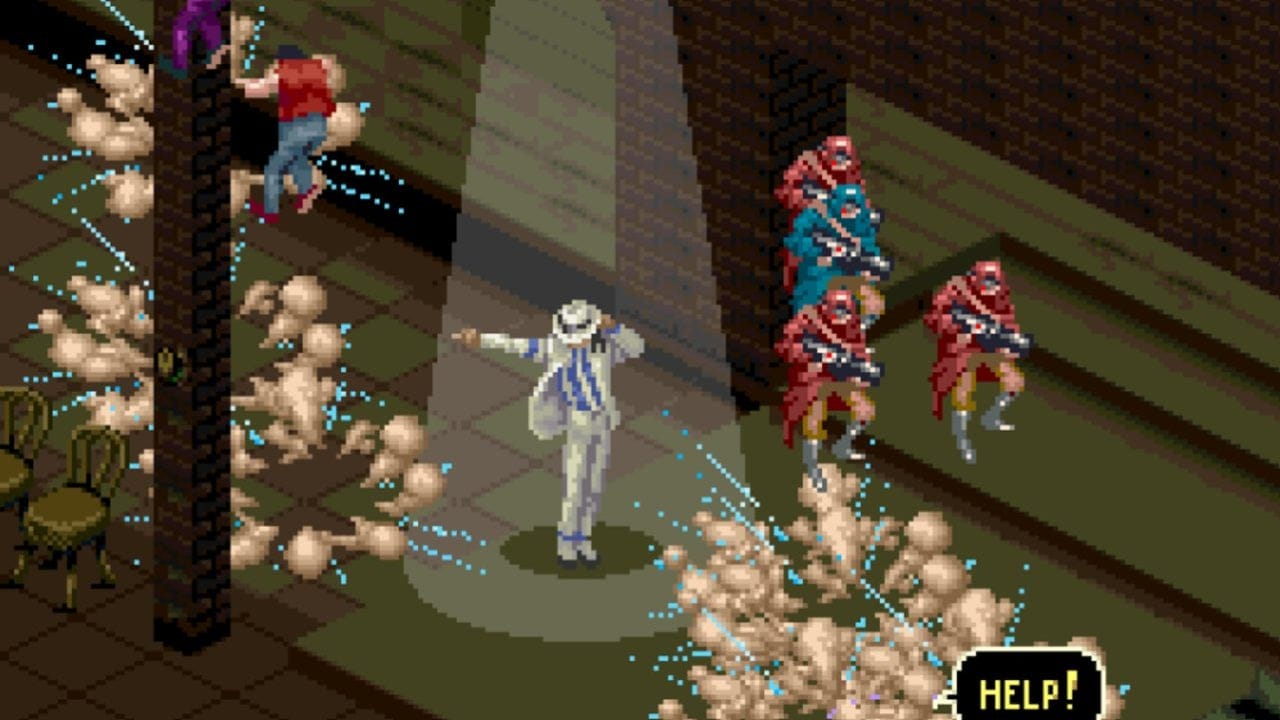
Michael Jackson's Moonwalker for the Sega Genesis is a strange relic. For a game that started as a straightforward beat 'em up, its core mechanic became a liability, a stark example of how real-world events can retroactively sour a game's legacy. Released in 1990, this title, also available on the Master System and in arcades, tasked players with rescuing children.
The game's premise came directly from the Moonwalker film, a direct-to-video release from 1988. That film, a compilation of music videos and short segments, was a massive success on VHS. It topped rental charts for 22 weeks in the United States and stayed on sales charts for 14 weeks. Jackson himself approached Sega, eager to translate his pop culture dominance into the burgeoning video game market. The result was a beat 'em up, specifically drawing inspiration from his "Smooth Criminal" music video.
The Rescue Mechanic That Aged Poorly
In the console versions of Moonwalker, the gameplay loop was simple: Michael Jackson navigated levels, fighting enemies with dance moves and magic. His primary objective was to find and rescue children hidden behind various objects in the environment. Rescuing these children not only advanced the stage but also restored Michael's health. Once all children were found, his chimpanzee companion, Bubbles, would appear, leading Michael to the boss fight against the villain, Mr. Big, according to *Sonic the Hedgehog 3*. The arcade version, however, focused more on direct combat without the explicit child-finding mechanic, a key difference that would later become significant.
This mechanic, innocent enough at the time of its 1990 release, took on a profoundly different meaning just three years later. The first sexual abuse allegations against Michael Jackson in 1993 cast a long shadow. Suddenly, a game where Michael Jackson "kidnapped" children, even with the stated goal of "saving" them, became deeply uncomfortable. It was a PR nightmare, a detail that certainly did not help Jackson's public image or legal defense. Softonic's article notes that what was "harmless" in 1990 was seen as "shady" by 1993.
A Collector's Complication
For collectors, Michael Jackson's Moonwalker presents a unique challenge. It's a genuine piece of Sega history, a licensed game from a global superstar at the peak of his fame. The game itself is a competent, if quirky, beat 'em up, featuring pixelated versions of Jackson's iconic songs. However, its problematic context makes it a difficult item to display or discuss without acknowledging the real-world baggage. This isn't about the game's monetary value, which varies wildly depending on condition, from loose cartridges with label damage to complete-in-box (CIB) copies with manual foxing. It's about its cultural weight.
The real story here is how a game's narrative can be completely reshaped by external events. What was once a simple heroic quest for children's safety became something else entirely. This forces collectors to grapple with the uncomfortable aspects of certain titles. Do you collect it for its historical significance, its gameplay, or do you avoid it due to its association? These are the debates that define parts of the collecting scene, especially when dealing with items that carry such heavy cultural baggage.
Jackson's Broader Sega Connections
The Moonwalker game was not the end of Michael Jackson's involvement with Sega. He famously collaborated on the soundtrack for Sonic the Hedgehog 3, though he eventually left the project before its completion. His influence on tracks like "Carnival Night Zone" and "Ice Cap Zone" is still debated among fans. He also made an appearance in the Dreamcast rhythm game Space Channel 5, lending his likeness and voice to the character "Space Michael."
Even after his death, there were discussions about a massively multiplayer online role-playing game (MMORPG) titled Planet Michael. Softonic's article points out that this proposed MMORPG, which they describe as a "money grab," fortunately never came to light. The Moonwalker game, however, remains a tangible artifact of a complex relationship between a pop icon and a video game giant. It's a game that was fun and successful in its era, but its legacy is now inextricably linked to a darker chapter in pop culture history. It stands as a prime example of how external narratives can permanently alter a game's perception, making it a fascinating, if uncomfortable, piece for any serious collector of Genesis titles.
What this hints at, for the scene, is the ongoing conversation about preservation versus problematic content. Do we simply forget games like Moonwalker because their context has shifted? Or do we preserve them, complete with their uncomfortable narratives, as historical documents? The market for such titles may not always reflect their cultural weight, but their place in the history of licensed games is undeniable.
RetroShell's Sega protector range covers Megadrive, Master System, Saturn and Dreamcast — the kind of protection your shelf already deserves.
Follow RetroShell on X for daily retro gaming news. Join the community on r/RetroShell.
Originally published by Softonic Articles. Read original article.