
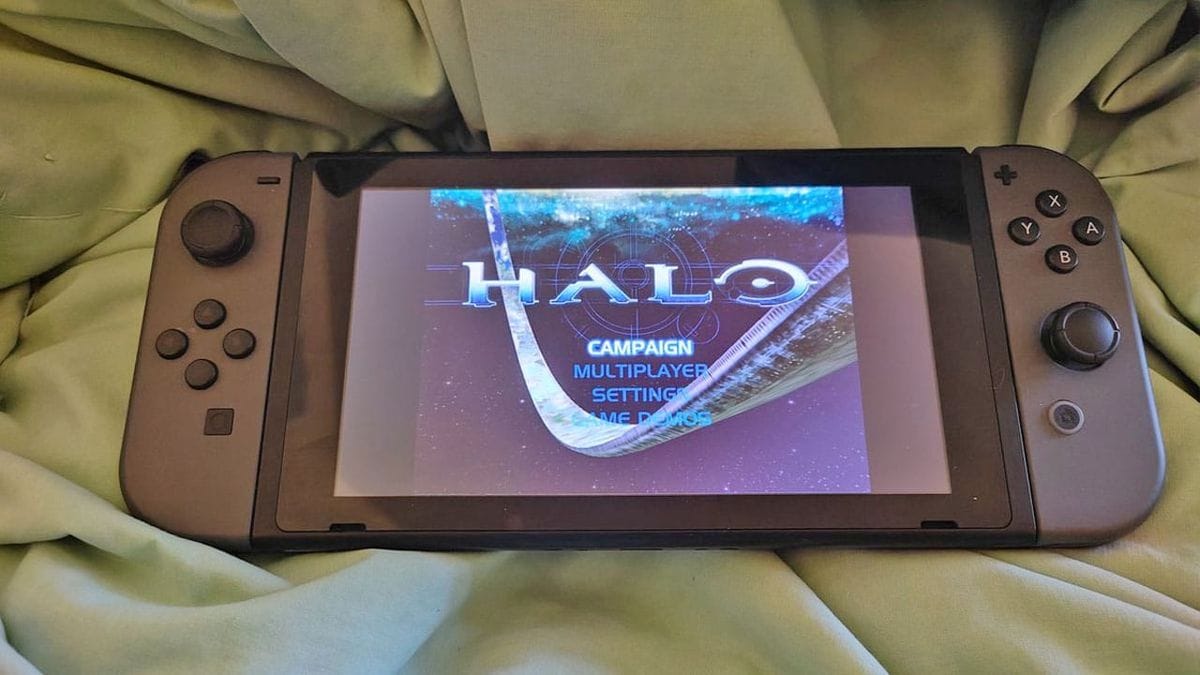
Halo: Combat Evolved Emulated on Nintendo Switch

The Nintendo Switch, with its custom Nvidia Tegra X1 system-on-chip, has proven itself a capable platform for many retro emulation projects, but running a full Xbox title natively seemed a distant prospect. However, modder @Generalkidd has achieved a significant technical feat, getting Halo: Combat Evolved to run directly on an original, modded Nintendo Switch console. This pushes the boundaries of what many thought possible for the console's ARM64 architecture, moving beyond the usual cloud streaming solutions often seen for more demanding titles.
RetroDodo reports that @Generalkidd accomplished this using an Arm64 build of Xemu, an open-source Xbox emulator. This approach bypasses any need for internet connectivity, running the game entirely on the Switch's hardware. The demonstration shows Halo running at a playable frame rate, a testament to both the emulator's optimisation and the Switch's underlying power.
Achieving native emulation of a console like the original Xbox on a handheld device is a complex undertaking. The Xbox, released in 2001, featured a 733 MHz Intel Pentium III CPU and a custom 233 MHz Nvidia NV2A GPU, a significantly different architecture from the Switch's ARM-based processor. Emulators like Xemu must translate these instructions in real-time, a process that demands considerable computational resources. The fact that a modded Switch, which typically runs its CPU at 1020 MHz and GPU at 768 MHz (when docked, lower in handheld mode), can handle this workload is impressive.
The Technical Hurdles of Xbox Emulation
The original Xbox's architecture presents unique challenges for emulation on ARM-based systems. Unlike simpler 8-bit or 16-bit consoles, the Xbox uses a complex x86 instruction set, which requires dynamic recompilation to run on the Switch's ARM64 instruction set. This process, known as Just-In-Time (JIT) compilation, converts x86 code into ARM64 code on the fly. The efficiency of this JIT recompiler is critical for achieving playable performance, especially for a graphically intensive first-person shooter like Halo.
What this hints at, for the scene, is a growing maturity in ARM-based emulation for more complex platforms. While the Analogue Pocket excels at FPGA-driven cycle-accurate replication for older systems, software emulation continues to push boundaries on general-purpose hardware. This achievement on the Switch highlights the potential for other demanding titles to eventually see native handheld play, provided the underlying emulator projects continue to advance.
Community Reaction and Future Prospects
The modding community has reacted with enthusiasm, with even Brian Jarrard, Community Director for Halo Studio, acknowledging the feat. His light-hearted response shows a recognition of the technical skill involved, even if it is outside official channels. This kind of community-driven development often leads to unexpected breakthroughs, much like the ongoing work on OSD firmwares for IPS retrofit kits in Game Boy Advance consoles, or the continuous refinement of FPGA cores for the MiSTer project.
The real story here is not just Halo on Switch, but the continued demonstration of what dedicated modders can achieve when pushing hardware limits. It suggests that as ARM processors become more powerful, and emulator development continues, we might see even more ambitious emulation targets become viable on handhelds. For now, it serves as a compelling proof-of-concept for the capabilities of the modded Nintendo Switch.
RetroShell makes the Nintendo protector set collectors actually reach for — precision-cut, British production, ships worldwide.
Follow RetroShell on X for daily retro gaming news. Join the community on r/RetroShell.
Originally published by RetroDodo. Read original article.