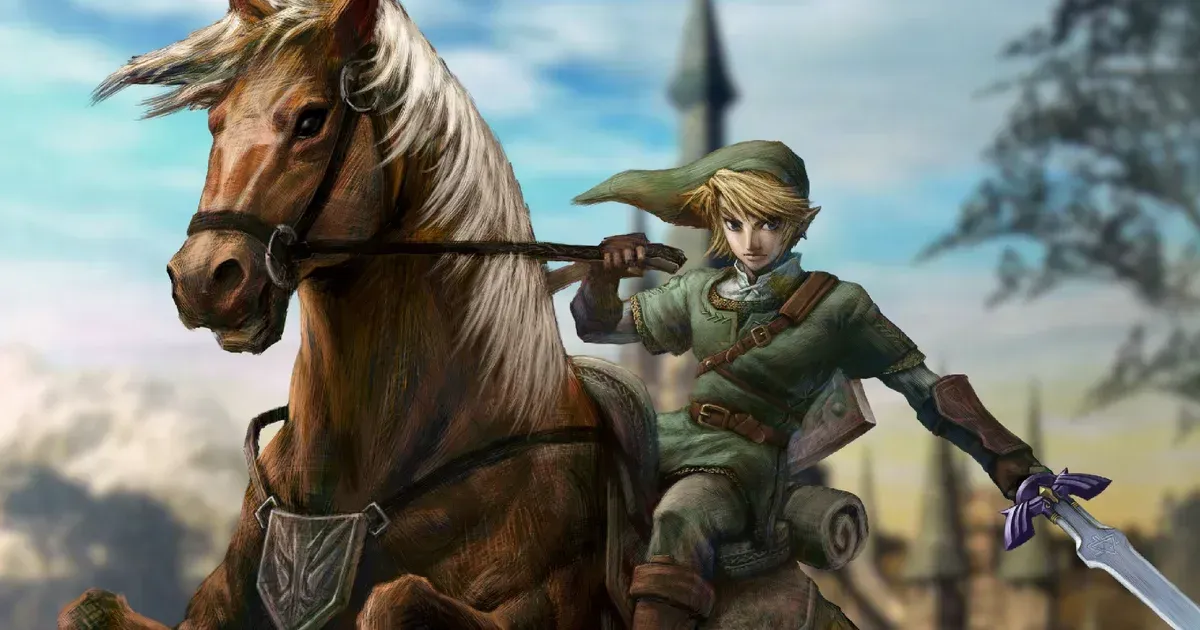
Miyamoto's Persistent Vision for Zelda's Horseback Combat

The quiet persistence of a lead designer, even when an idea is initially shelved, often dictates the eventual shape of a franchise in ways that are rarely obvious to the player. This is precisely the case with Shigeru Miyamoto's vision for horseback combat in The Legend of Zelda series. A detail from a 2004 Edge magazine interview, recently highlighted by GAM3S.GG, reveals that the mounted sword fighting in Twilight Princess was a direct result of Miyamoto's decade-long advocacy for the mechanic.
Series director Eiji Aonuma confirmed this in Edge issue #138, following the game's reveal at E3 2004. He stated, "One of the things about the horseriding is that it's really Mr. Miyamoto's favourite. He always wanted to do that; he wanted to do that in Ocarina of Time but it didn't happen." This offers a rare glimpse into the internal creative pressures that shape a major Nintendo title.
The original Ocarina of Time featured Link's trusty steed, Epona, and expansive areas like Hyrule Field. Players could fire arrows from horseback, certainly, but the ability to swing a sword while mounted was conspicuously absent. The technical limitations of the Nintendo 64 hardware, or perhaps simply a lack of development time, meant Miyamoto's full vision for mounted combat remained unrealised at the time.
The Long Road to Mounted Combat
Aonuma's account further explains how the idea resurfaced. He recalled Miyamoto's earlier mentions during Ocarina of Time's development. When pitching concepts for the new game, Aonuma brought it up again. Miyamoto, it seems, seized the opportunity. "Mr. Miyamoto wanted to see Link fight on horseback, so I added that," Aonuma recounted. This demonstrates a remarkably direct line from a creator's enduring wish to a core game mechanic.
The inclusion of horseback combat was not a minor addition. It became central to Twilight Princess's initial public presentation. The famous "blades will bleed" trailer, which introduced the game at E3 2004 even before its subtitle was announced, prominently featured these sequences. Nintendo deliberately led with this mechanic, a clear indication of its perceived importance and impact.
What this hints at, for the scene, is how often design elements that feel organic to a game's identity are, in fact, the product of persistent individual advocacy. It is not merely about technical feasibility, but about a director's conviction. The mechanic felt so natural in Twilight Princess that many players retroactively assume it was always part of the Zelda formula. That is a sign of genuinely successful integration.
Reading a Designer's Intent
Aonuma also offered a telling observation about Miyamoto's communication style in that same 2004 Edge interview. He noted, "I have a lot of communication with Mr. Miyamoto and sometimes I can't tell if he is kidding, but sometimes he mentions things so many times that I think maybe he really wants to do it." This offers a window into the subtle dynamics of creative collaboration at Nintendo. A repeated suggestion, even if initially light-hearted, can carry significant weight over time.
The success of the mounted combat in Twilight Princess was partly due to the game's expanded Hyrule Field and its grittier aesthetic. These elements provided the necessary scope and atmosphere for such spectacle to breathe. Riding through canyons on Epona, smoothly swapping between sword strikes and bow shots, felt like a proper action sequence. It was not a mere gimmick, but a well-executed core gameplay loop.
The real story here is not just about a single mechanic, but about the iterative nature of game design. Ideas are often born, shelved, and then resurrected when the technology, context, or creative will aligns. Miyamoto's vision for horseback combat was not a disaster, just a mistake of timing for Ocarina of Time. Its later inclusion shows a commitment to refining and realising concepts, even if it takes a decade.
Implications for Future Remakes
With reports of an Ocarina of Time remake potentially in development, this historical detail raises an obvious question. Will a modern version finally add the mounted sword combat Miyamoto originally wanted? The Nintendo 64 original omitted it entirely. Current hardware would present no technical barrier to its inclusion.
Given Miyamoto's track record of circling back to ideas he cares about, and Aonuma's own habit of revisiting unfinished franchise business, a remake could be the moment the original game finally receives the feature its successor made famous. This would not be an alteration of the original's spirit, but rather a completion of a long-held design intent. It would be an interesting development, certainly, for those who appreciate the quiet politics of preservation and creative evolution.
If you read this far, you're the audience for Player Clothing: individually numbered, limited-edition retro-gaming t-shirts. One print run per design, then gone.
Follow RetroShell on X for daily retro gaming news. Join the community on r/RetroShell.
Originally published by GAM3S.GG. Read original article.